Leather Watch Straps That Age Well
What the appraisal found
- Hirsch Liberty — Best overall
- ColaReb Firenze — Best upgrade
- Barton Weathered Brown Leather Watch Band — Best budget pick
Widths, materials and construction below reflect the brands' own documented specifications.
A watch case is built to outlive its owner; the strap is the wear item, flexing tens of thousands of times against sweat and weather. That makes the strap the one accessory where construction quality shows up within a year. The good news: the specs that matter are all on the product page, if you know which lines to read. The bad news: most listings print the line that sells widths and colors and skip the two lines that decide how the strap looks in year three.
Measure the lug width first
Everything starts with the distance between the lugs, measured in millimeters at the spring bar. Most watches take 18, 20 or 22 millimeters, and a strap even one millimeter off will not seat. Check the buckle end too: many straps taper — a 20-millimeter attachment tapering to an 18-millimeter buckle is typical — and the taper changes how the strap sits under a cuff. Quick-release spring bars, which flip out by hand with a fingernail, have become standard enough that paying extra for them is unnecessary; Hirsch and Barton both build them into these picks at no premium.
The measurement itself takes thirty seconds. Set a ruler between the inner edges of the lugs, right where the spring bar sits, and read the gap in whole millimeters — not at the widest point of the case, which reads larger than the actual gap. Manufacturers publish lug width for current models, and serial numbers on the case back usually identify the reference well enough to look it up. Forcing a strap that is a size off does not fail on day one; it loads the spring bar sideways and wears the lug channels until something gives.
Thickness decides where the strap can go
Thickness is the least-published spec and the first one your cuffs notice. A strap flexes at two points, the attachment at the case and the crease at the buckle, and stiff leather at 4 millimeters holds its curve all day while a thinner dress strap breaks in within a week. A brand that prints thickness at both ends is doing you a favor; a brand that prints only width is hiding the number that decides whether the strap disappears under a shirt cuff or pushes it open. Attachment thickness matters more than buckle-side thickness, because that is where the sleeve meets the case and where the clearance is tightest.
There is no universal right answer here, only a trade to make consciously. A thick strap on a steel sports watch looks correct and wears like it sounds. The same strap under a suit jacket binds the shirt cuff every time the wrist turns. Buy for the wardrobe the watch actually lives in, not the one in the product photo.
Thickness also explains the taper logic. A strap that narrows from attachment to buckle concentrates the stiff, structured part near the case and leaves the tail free to wrap the wrist, which is why a tapered strap feels slimmer than a straight one at the same attachment width. Straight-cut straps exist for a different reason: on small vintage cases a straight strap keeps the lug line honest and the hole spacing predictable. Neither is better; each is a decision about where the mass sits.
Construction is the aging story
A dress strap is three parts: the upper leather you see, a padding core, and the lining leather that rides against your skin. Hirsch, the Austrian maker rooted in a 1765 family tannery and building straps in Klagenfurt since 1945, documents the assembly outright — most of its straps use the Rembordé technique, which the company patented in 1955 and which joins upper and lining with sealed edges to keep out sweat and water. The lining is the part buyers skip and wearers feel: Colareb, the Italian maker, documents a calfskin lining on its Firenze strap that it describes as hypoallergenic and breathable. Single-piece designs skip the lining question by construction. Hirsch’s Liberty uses vegetable-tanned saddle leather from the back of the hide, finished with edges hand-lacquered in three layers, per the brand’s product page — a belt-style build that patinas instead of delaminating, the same logic that makes full-grain belts worth the price.
The lining is the part you feel
The lining never shows in a product photo, and it is the surface your wrist lives on. Sweat is salty and mildly acidic; it migrates through the upper, pools against the lining, and works on dyes and adhesives from the inside. A smooth calfskin lining slides over the wrist, takes dye evenly and wipes clean; a rough unfinished lining grabs, darkens unevenly and can transfer color onto a shirt cuff.
That is why edge construction matters more on lined straps than on single-piece ones. On a lined strap, the edge is the seam where upper, core and lining meet, and an open edge lets moisture wick into the sandwich. A sealed edge — stitched, folded or Rembordé — closes that path, which is the whole point of the technique. Single-piece builds sidestep the problem entirely: with no lining to separate, the failure mode shifts from delamination to surface wear, which shows early and stays cosmetic for years.
The picks
Best overall: Hirsch Liberty. The brand documents a single-piece, vegetable-tanned saddle leather build with a contrasting backstitched seam and attachment widths of 18, 20, 22 and 24 millimeters. The trade-off is bulk: the brand lists 4.0 millimeters of thickness at both attachment and buckle, so it disappears under a jacket cuff but fights a dress shirt’s. Hirsch’s own care note says to rinse it under lukewarm water and dry it — rare for a leather strap to be washable at all.
Best upgrade: ColaReb Firenze. Made in Italy by a company crafting straps since 1990, the Firenze pairs a soft vintage-finish upper with hand-made loops and a polished buckle set off by top and bottom stitching, and the brand states its calfskin lining is hypoallergenic and breathable. The trade-offs are range and uniformity: the Firenze comes only in 20 and 22 millimeters, and Colareb says the small imperfections in the leather are characteristic, so expect piece-to-piece variation.
Best budget pick: Barton Weathered Brown Leather Watch Band. At a documented $50, Barton offers eight widths from 16 to 24 millimeters, quick-release bars, and a choice of three buckle finishes — the widest size coverage of the three, which makes it the default answer for awkward lug widths. The honest caveat: the listing documents the hardware and sizing but not the leather grade or lining, so you are trading a fully documented spec sheet for price and fit.
How a strap actually fails
Straps fail in a short list of ways, and none of them is sudden. The edge coating cracks first, almost always at the flex crease near the lugs, because the finish has less give than the leather beneath it. Delamination follows where sweat sits longest, usually the underside against the case, and it announces itself as a lifted corner where the upper no longer moves with the core. The holes elongate once the leather has thinned, and the tear line follows the direction the hole was punched.
Each failure has a different signature, which makes inspection honest work. Cracked edges are visible from across the room. Delamination has to be felt — run a thumb along the edge and press the layers together; any sliding between upper and lining is the early warning. Elongated holes mean the strap is past saving, but they also mean the leather lasted long enough to wear through, which is the compliment.
Inspect on a schedule that matches wear. A strap worn twice a week deserves a look at the lug creases and the hole nearest the tongue once a month; sweat-heavy summer wear halves that interval. The inspection itself is two minutes: flex the strap and watch the edge coating, press the layers together at the case end, and pull the tongue lightly against the buckle. Catching a cracked edge early is the difference between a repair and a replacement.
What the buckle and keepers tell you
Hardware is the cheapest thing on a strap to cut and the easiest thing to inspect. The buckle frame should not flex when you pull the tongue against it; plating worn through at the tongue tip, on a strap that is supposed to be new, tells you how the following year goes. Keepers should sit tight and stay put; a loose keeper is cosmetic, a cracked one is not. Check the stitching at the attachment end too — the short section that loops the spring bar carries the entire load of the watch, and a handful of stitches per side is normal, so the leather itself has to do the holding. A failed stitch there is a repair; a torn strap end is a replacement.
Care buys the second half of the strap’s life
Routine is shorter than most care guides suggest. Dry the strap after a wet day and keep it out of a closed watch box until it has dried. If you wear the same watch daily, alternate between two straps, because leather needs a day to dry out fully between wears. Conditioning is where beginners overshoot — a strap is a few square inches of leather and needs a fraction of what a jacket takes, and a light hand beats a generous one — the difference between patina and damage is covered in leather patina vs. damage.
Whichever you choose, the strap’s second life depends on care — our materials and care guides cover conditioning without darkening the leather, and checking secondhand leather applies the same edge and lining inspection to used finds.
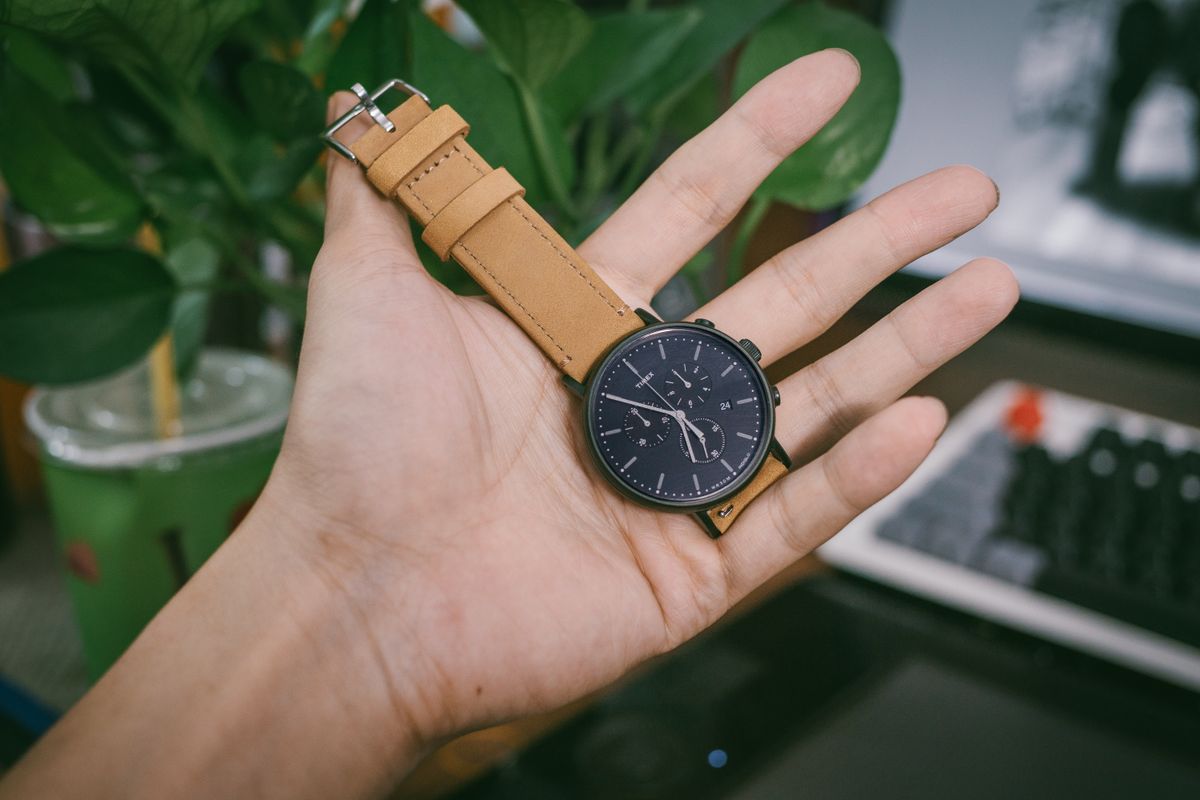
The picks
Buying through links below may earn us a commission — it does not change your price.
- 1
Hirsch Liberty — Best overall
Hirsch documents a single-piece build in vegetable-tanned saddle leather from the back of the hide, with three hand-lacquered edge layers, a contrasting backstitched seam and quick-release bars in 18-24 mm widths. Trade-off: a documented 4.0 mm thickness at attachment and buckle makes it bulky under a slim cuff.
Check current price - 2
ColaReb Firenze — Best upgrade
Made in Italy by a strap crafter working since 1990, the Firenze combines a soft vintage-finish upper with hand-made loops and a calfskin lining the brand documents as hypoallergenic and breathable. Trade-off: only 20 and 22 mm widths, and Colareb states the leather's small imperfections vary piece to piece.
Check current price - 3
Barton Weathered Brown Leather Watch Band — Best budget pick
At a documented $50, Barton covers eight lug widths from 16 to 24 mm with quick-release bars and three buckle finishes — the widest fit range of the three. Trade-off: the listing documents sizing and hardware but not the leather grade or lining, so the spec sheet is thinner than the price suggests.
Check current price
Comparison
| Hirsch Liberty | ColaReb Firenze | Barton Weathered Brown | |
|---|---|---|---|
| Lug widths | 18 / 20 / 22 / 24 mm | 20 / 22 mm | 16-24 mm (eight sizes) |
| Upper leather | Vegetable-tanned saddle leather, barrel-dyed, single piece | Soft vintage-finish Italian leather | Weathered leather; grade not documented on listing |
| Lining | Single-piece build, no separate lining | Calfskin lining, documented hypoallergenic and breathable | Not documented on listing |
| Edge finish | Hand-lacquered in three layers | Not documented; hand-made loops | Not documented on listing |
| Quick release | Yes, HIRSCH Quick-Release System | Not documented on listing | Yes |
The shielding works in the lab; the crime barely exists. What independent tests…
Rib count, canopy fabric and the opening mechanism decide whether an umbrella…
Pique and point seams, hand-sewing versus machine work, the four leathers that…
Gram weights, interlining choices, self-tipped ends and the slip stitch on the…